
COSTA DEL SOL — INVESTMENT
The Hidden Costs of Buying Property in Spain — And How to Plan for Them
our Expert Guide to Living and Investing on the Costa del Sol


It begins with a number. A property you have been thinking about for months — perhaps a two-bedroom apartment in a new development above Mijas, or a resale villa with sea views near Fuengirola — carries a price tag that fits your budget with a little room to spare. You feel comfortable. You feel ready. And then your lawyer sends over a comprehensive cost breakdown, and the number is suddenly, disconcertingly, larger than you expected.
This is one of the most common experiences international buyers have in the Spanish property market — not because the costs are hidden in any dishonest sense, but because the Spanish system places the majority of transaction taxes and fees on the buyer rather than the seller, and those costs are rarely shown front and centre on a property listing. Understanding them in advance is not just sensible — it is essential. Failing to budget accurately for the true cost of acquisition is one of the primary causes of deal failures, delayed completions and genuine financial stress among buyers who arrived on the Costa del Sol with every intention of making a smooth and considered purchase.
The good news is that these costs are, for the most part, entirely predictable. They are set by law or regional decree. There are no surprises if you know where to look — and knowing where to look is precisely what this article is designed to help you do.
“Budget an additional ten to fourteen percent on top of the purchase price. Everything else flows from getting that number right.”
The Purchase Tax: Your Largest Additional Cost
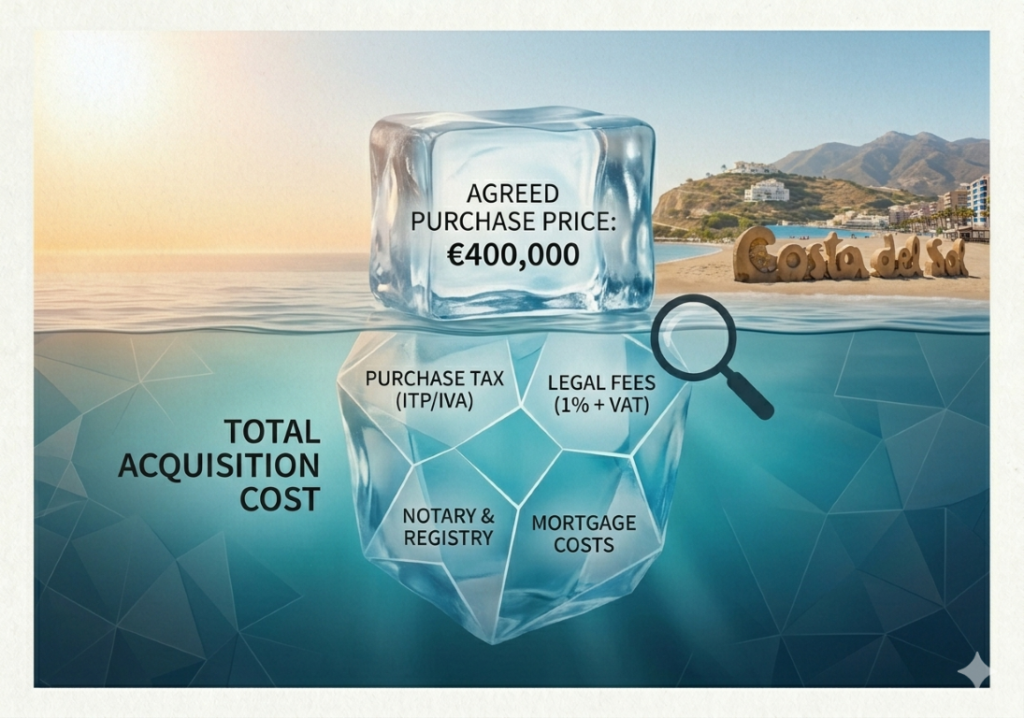
The single largest cost beyond the agreed purchase price is the purchase tax, and the rate you pay depends entirely on whether you are buying a new build or a resale property.
For resale properties in Andalucía — which covers the entire Costa del Sol — the applicable tax is the Impuesto sobre Transmisiones Patrimoniales (ITP), the Property Transfer Tax. The rate in Andalucía is seven percent of the purchase price, which compares favourably with other Spanish regions: in Catalonia, for example, the same tax is ten percent, and in Valencia it has recently been reduced from ten to nine percent. On a €400,000 property on the Costa del Sol, this represents a €28,000 tax bill — and it must be paid within thirty business days of signing the deed at the notary, before the property can be registered in your name.
For new-build properties purchased directly from a developer, the tax structure is different. Instead of ITP, buyers pay VAT (IVA in Spain) at ten percent of the purchase price, plus a stamp duty charge known as Actos Jurídicos Documentados (AJD) of approximately 1.2 percent in Andalucía. On that same €400,000 new build, the tax bill comes to approximately €44,800 — meaningfully higher than the resale equivalent. This difference is a genuine financial consideration when comparing equivalent properties across both categories.
It is also worth noting that Spanish tax authorities now calculate purchase tax on the higher of two values: the agreed purchase price, or the Valor de Referencia — a cadastral reference value determined by the Spanish tax office. In most cases on the Costa del Sol, the purchase price exceeds the reference value, so this has little practical impact. However, buyers purchasing at what they believe to be a discounted price should be aware that the tax calculation may not reflect any discount negotiated below the market reference value.
Legal, Notary and Registry Fees
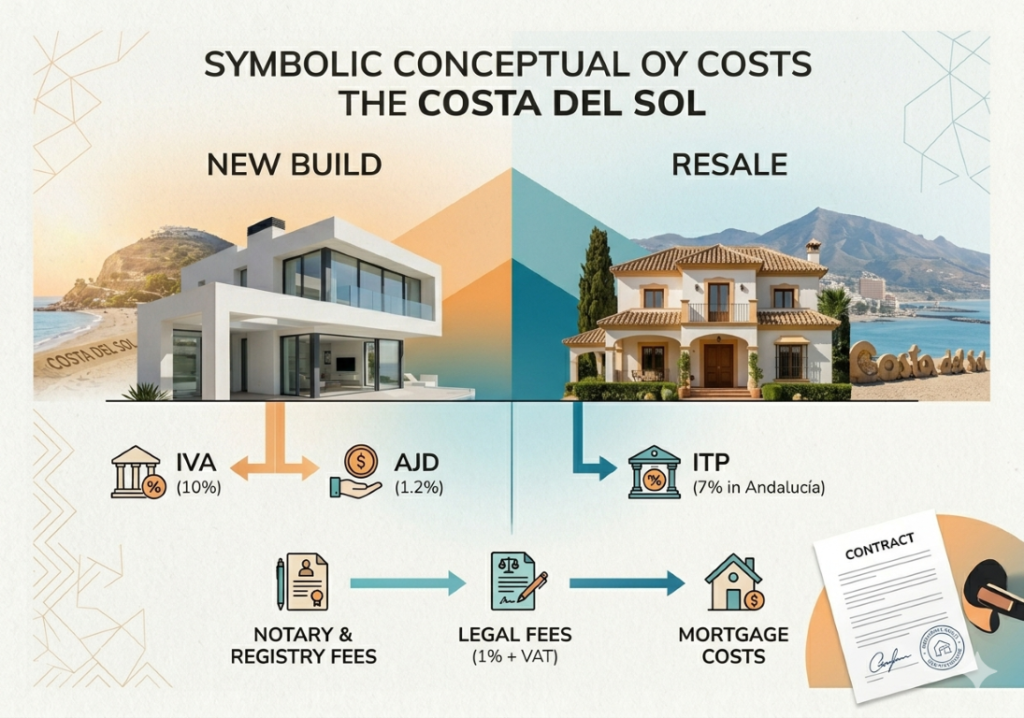
Beyond the purchase tax, every property transaction in Spain requires three additional layers of professional cost, all of which are mandatory.
Notary fees are regulated by law on a sliding scale based on the purchase price and the complexity of the deed. For a typical residential transaction on the Costa del Sol, budget between €800 and €1,500. Once the deed is signed at the notary, it must be inscribed at the Land Registry (Registro de la Propiedad), with associated fees of approximately €400 to €800 depending on the property value.
Legal fees represent the cost most buyers are aware of but sometimes underestimate. While engaging a Spanish property lawyer is not legally mandatory, for any international buyer it is absolutely non-negotiable. A good property lawyer will check the property for outstanding debts and charges, verify that planning permissions are in order, confirm the property is correctly registered, arrange your NIE number (the tax identification number required for all Spanish property transactions) and represent you at the notary. Standard legal fees run at approximately one percent of the purchase price plus 21 percent VAT — on a €400,000 purchase, that is €4,840 all-in. Some firms offer fixed fees for simpler transactions, which can represent a saving at higher price points.
Mortgage Costs: What You Pay, What the Bank Pays
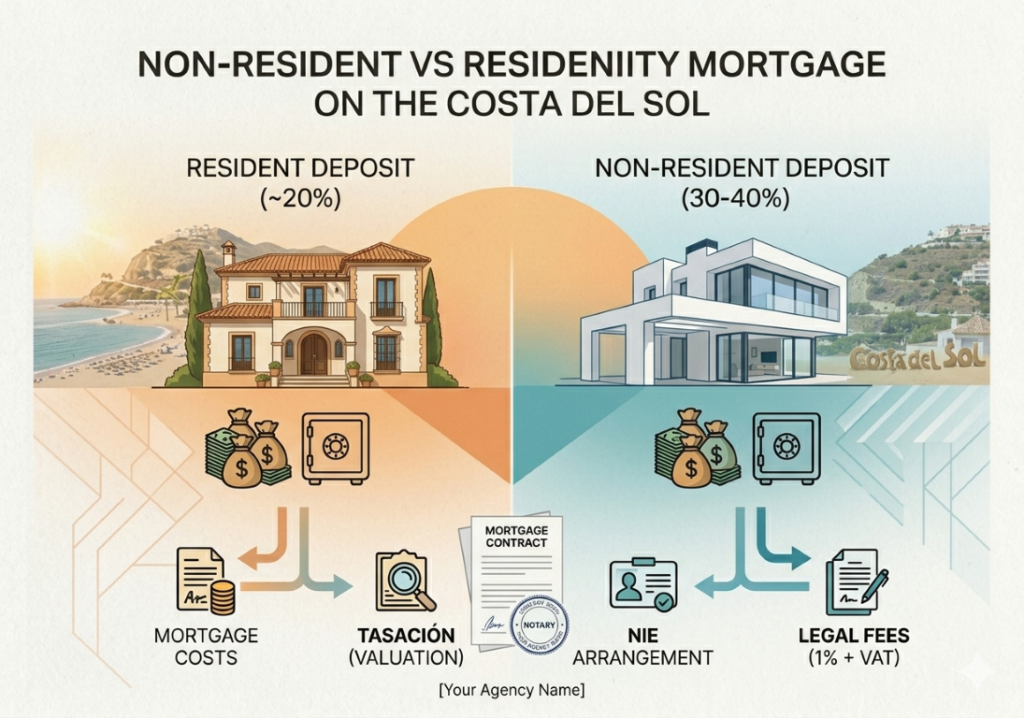
If you are financing your purchase with a Spanish mortgage, the 2019 Mortgage Law Reform significantly improved the position for borrowers: banks now cover the notary and registry costs associated with the mortgage deed itself, the mortgage tax, and their own arrangement costs. As a buyer, you are left responsible for two items: the mandatory property valuation (tasación), which costs approximately €400 to €700 depending on the property and the lender, and any bank arrangement fee if applicable — though many lenders on the Costa del Sol have removed this charge for competitive reasons.
Non-resident buyers should also be aware that Spanish banks typically require a deposit of thirty to forty percent of the purchase price (compared to approximately twenty percent for Spanish fiscal residents), and that these funds need to be available in addition to, not as part of, the budget for taxes and fees. For a €500,000 property, a non-resident should realistically have €250,000 to €285,000 in accessible funds — covering the deposit, purchase taxes and all professional fees.
“The costs are not hidden. They are simply rarely explained. Knowing them in advance transforms a stressful surprise into a straightforward budget line.”
The Ongoing Costs: What Owning Costs You Each Year
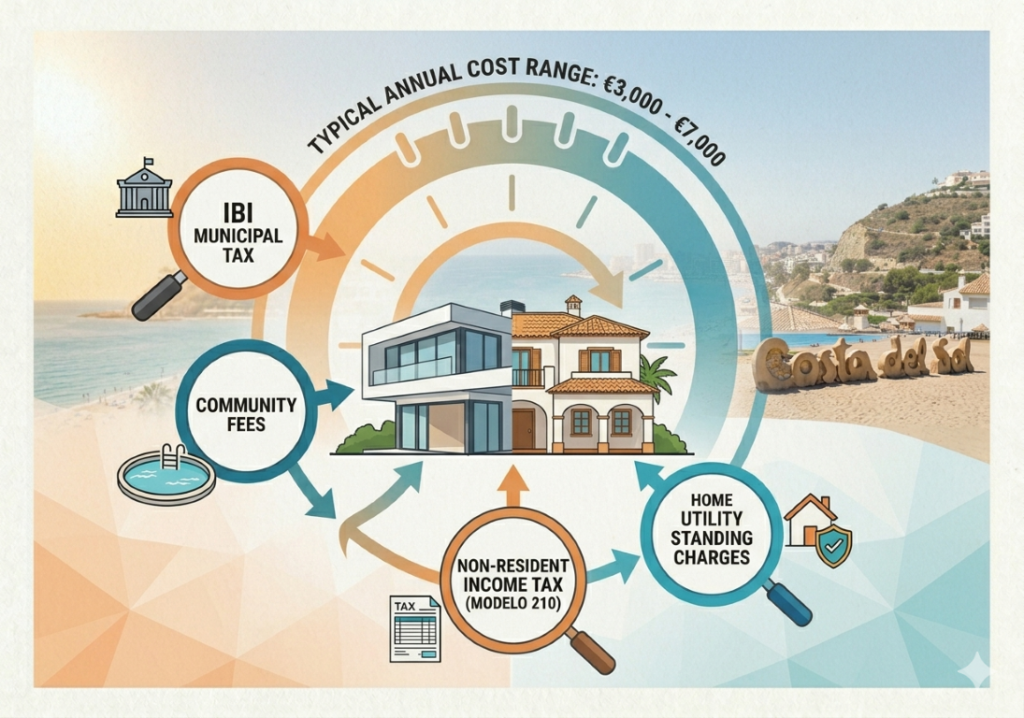
Beyond the one-time acquisition costs, owning property on the Costa del Sol as a non-resident carries a set of predictable annual obligations that buyers frequently overlook until they receive their first year’s bills.
The IBI (Impuesto sobre Bienes Inmuebles) is the annual municipal property tax, calculated on the cadastral value of the property. For most Costa del Sol properties, this runs between €300 and €1,500 per year, though larger or higher-value properties will sit towards the upper end of that range.
Community fees apply to any property within a residential complex or urbanisation with shared amenities — which describes the vast majority of new-build developments on the Costa del Sol. Expect to budget €100 to €500 per month depending on the facilities provided; luxury developments with pools, gyms, security and landscaped gardens naturally command higher fees but also typically support stronger rental yields.
Non-resident income tax is perhaps the most frequently overlooked obligation. Under Spanish law, non-resident property owners must file an annual tax return (Modelo 210) regardless of whether they rent the property out or not. For an unrented property, the tax is calculated as 1.1 percent of the cadastral value, taxed at 19 percent for EU/EEA residents or 19 percent for non-EU residents following a landmark 2025 ruling by Spain’s National Court that aligned the rates for non-EU owners. For most Costa del Sol properties, this represents an annual obligation of between €300 and €800.
Home insurance (€200 to €600 per year), utility standing charges and, for those purchasing for rental purposes, a property management fee of eight to fifteen percent of rental income complete the picture. Taking all of these into account, annual ownership costs for a non-resident on a mid-market Costa del Sol property typically run between €3,000 and €7,000 per year before any mortgage payments.
The Andalucía Advantage
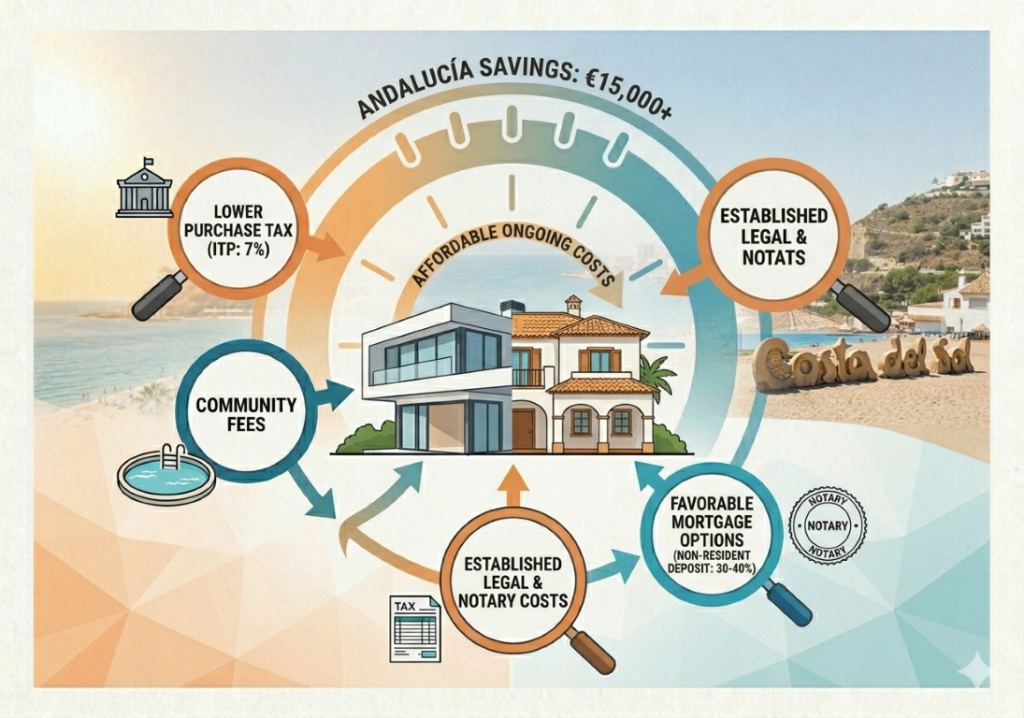
One point that is worth underscoring for buyers comparing the Costa del Sol with other Spanish regions: Andalucía is one of the most cost-effective regions in Spain in which to buy property. The seven percent ITP on resale properties compares favourably with rates of up to ten percent in other autonomous communities. On a €500,000 purchase, that difference alone amounts to €15,000 — a saving that can meaningfully offset legal and professional fees.
None of these costs should deter a buyer who has done their research and budgeted correctly. The Costa del Sol’s property market continues to offer a combination of lifestyle, climate, rental yield and long-term capital appreciation that justifies every line of the cost table. The key is simply to know those lines before you make your offer, not after you have committed to a purchase price that leaves no room for the reality of acquisition costs in Spain.
Thinking About Making the Move?
Our team of specialist advisors has been helping international buyers find their perfect home on the Costa del Sol for 15 years. Whether you are at the early stages of research or ready to view, we would love to hear from you.
T: +34 951 177 422 E: info@mosaicrealty.es W: www.mosaicrealty.es