
COSTA DEL SOL — INVESTMENT
Golden Visa Spain: Is Property Investment Still a Pathway to Residency?
our Expert Guide to Living and Investing on the Costa del Sol


For over a decade, it was one of the most straightforward propositions in the European property market: purchase a property in Spain worth €500,000 or more, and secure the right to live, work and travel freely across the Schengen Area. The Spain Golden Visa programme, introduced in 2013 in the depths of the Spanish recession as a mechanism to attract foreign capital, became one of Europe’s most popular residency-by-investment schemes, issuing more than 14,500 visas through real estate investment in the decade following its launch.
On 3 April 2025, it came to a definitive end. No new applications have been accepted since that date. The decision, announced by Prime Minister Pedro Sánchez in April 2024 and passed by the Spanish Congress of Deputies in December 2024, was driven primarily by housing affordability concerns — the argument that a programme which incentivised high-value property purchases in Spain’s most desirable cities had contributed to price pressures that made housing unaffordable for local residents, particularly in Madrid, Barcelona and Málaga.
For international buyers on the Costa del Sol who had been considering the Golden Visa as part of their motivation to purchase, the closure of the programme raises a set of important and entirely understandable questions. Is property investment in Spain still worthwhile without the residency benefit? What alternatives exist for those who genuinely wish to relocate? And what does this change mean for the market that so many of our clients have been building towards?
“The Golden Visa is gone. The reasons to buy and live on the Costa del Sol are not.”
What the Golden Visa Was — and What It Was Not
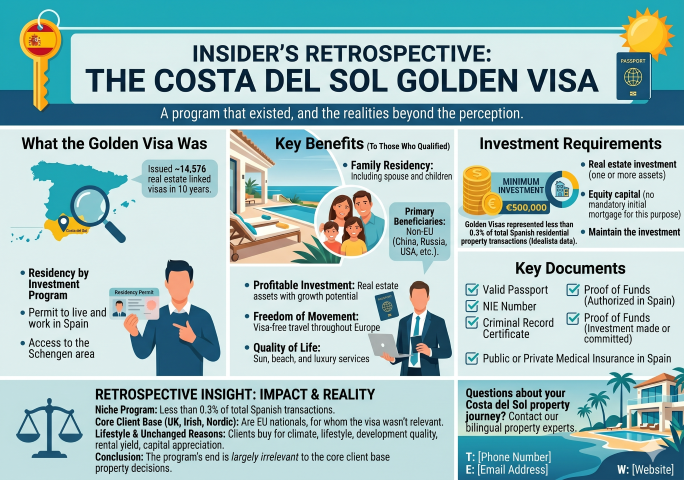
It is worth being clear about what the Golden Visa programme actually represented in practice, because the gap between perception and reality was often significant. In the decade it operated, the programme issued approximately 14,576 visas linked to real estate investment. In a country of 48 million people conducting millions of property transactions each year, this was, as multiple analysts noted, a very small number. Golden Visas accounted for less than 0.3 percent of Spain’s total residential property transactions, according to Idealista data.
For the vast majority of buyers on the Costa del Sol — British, Irish, Scandinavian and Northern European buyers relocating for lifestyle, retirement, or part-time living — the Golden Visa was never particularly relevant. EU nationals could already live, work and travel freely across Spain without any visa requirement. British buyers, post-Brexit, faced different residency rules regardless of the Golden Visa, and the programme’s primary beneficiaries were non-EU nationals from China, Russia, the United States and similar markets who sought the Schengen travel benefits the visa conferred.
For our core client base of UK, Irish and Northern European buyers, the end of the Golden Visa is, in practical terms, largely irrelevant to their property purchase decisions. The reasons they buy on the Costa del Sol — the climate, the lifestyle, the quality of new developments, the rental yield potential, the capital appreciation track record, the community — have not changed.
Existing Holders: Your Rights Are Protected
If you hold a current Spanish Golden Visa obtained through a real estate investment made before 3 April 2025, your rights are fully preserved under the transitional provisions of the new law. You may continue to renew your visa on the same terms as before, provided you maintain your original investment and visit Spain at least once during each annual visa period. After five years of residency, you may apply for permanent residency, and after ten years, for Spanish citizenship. The programme’s end affects only new applications — not those already in the system.
Residency Alternatives for Non-EU Buyers in 2026
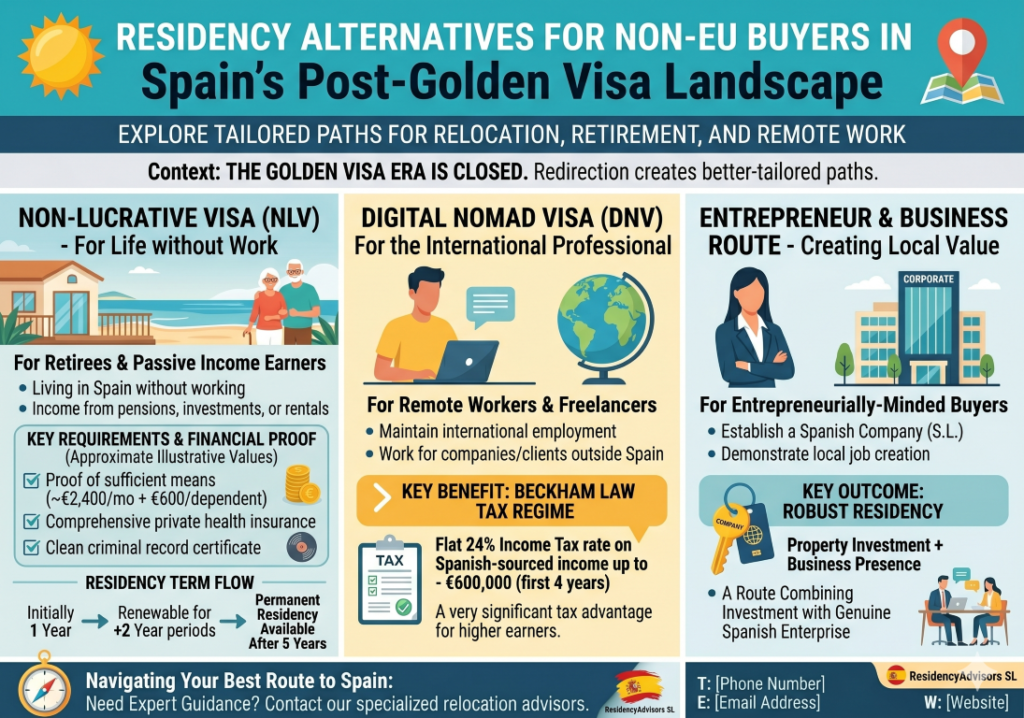
For non-EU buyers who genuinely wish to establish residency in Spain — whether for retirement, remote working or relocation — the Golden Visa closure has not left a void so much as redirected attention towards alternatives that, for many buyers, are actually better suited to their circumstances.
The Non-Lucrative Visa is the most established route for buyers who wish to live in Spain without working there — typically retirees or those with passive income from investments, pensions or rental income. It requires proof of sufficient financial means (approximately €2,400 per month for the principal applicant, plus €600 per month per dependent), comprehensive private health insurance, and a clean criminal record. The visa is initially granted for one year and renewable for two-year periods thereafter, with permanent residency available after five years.
The Digital Nomad Visa, introduced in 2023, has attracted growing interest from professional buyers who work remotely for companies or clients based outside Spain. It allows holders to live in Spain while maintaining their international employment, and comes with access to Spain’s favourable Beckham Law tax regime for the first four years of residency — a flat 24 percent income tax rate on Spanish-sourced income up to €600,000, which can represent a very significant tax advantage for higher earners relocating from high-tax northern European markets.
For entrepreneurially-minded buyers, establishing a Spanish company (a Sociedad Limitada) and demonstrating local job creation can form the basis of a robust residency application — a route that combines property investment with a genuine business presence in Spain.
“For EU buyers, the Golden Visa was never the point. The Costa del Sol’s lifestyle, climate and investment fundamentals are the point — and those remain entirely unchanged.”
The Investment Case Stands on Its Own
Perhaps the most important message for buyers who had been factoring the Golden Visa into their decision-making is this: the property investment case on the Costa del Sol does not depend on the visa. It never did for most buyers, and it does not now.
Property prices across the region have risen seven to ten percent annually in recent years, driven not by visa-seeking investors but by sustained organic demand from lifestyle buyers, remote workers and retirees across Northern Europe and beyond. Foreign buyers accounted for approximately 14.6 percent of all Spanish property transactions in 2024, according to Idealista — a record figure that was recorded even after the Golden Visa abolition had been announced. Rental yields in prime Costa del Sol locations continue to run at six to ten percent in strong tourist markets. And the pipeline of new development of the quality now coming to market — energy-efficient, architect-designed villas and apartments with resort-standard amenities and panoramic sea views — represents an opportunity that exists entirely independently of any residency programme.
The Costa del Sol has rewarded buyers who acted for the right reasons in every decade since the region emerged as an international property destination. Those reasons — the climate, the community, the lifestyle, the investment fundamentals — have proven more durable than any individual policy. The Golden Visa chapter has closed. The Costa del Sol chapter, for those who understand it properly, is as compelling as it has ever been.
Thinking About Making the Move?
Our team of specialist advisors has been helping international buyers find their perfect home on the Costa del Sol for 15 years. Whether you are at the early stages of research or ready to view, we would love to hear from you.
T: +34 951 177 422 E: info@mosaicrealty.es W: www.mosaicrealty.es